2016
Cemetery Lanterns
Installation exploring grief at Aalborg general cemetery.
00 / Summary
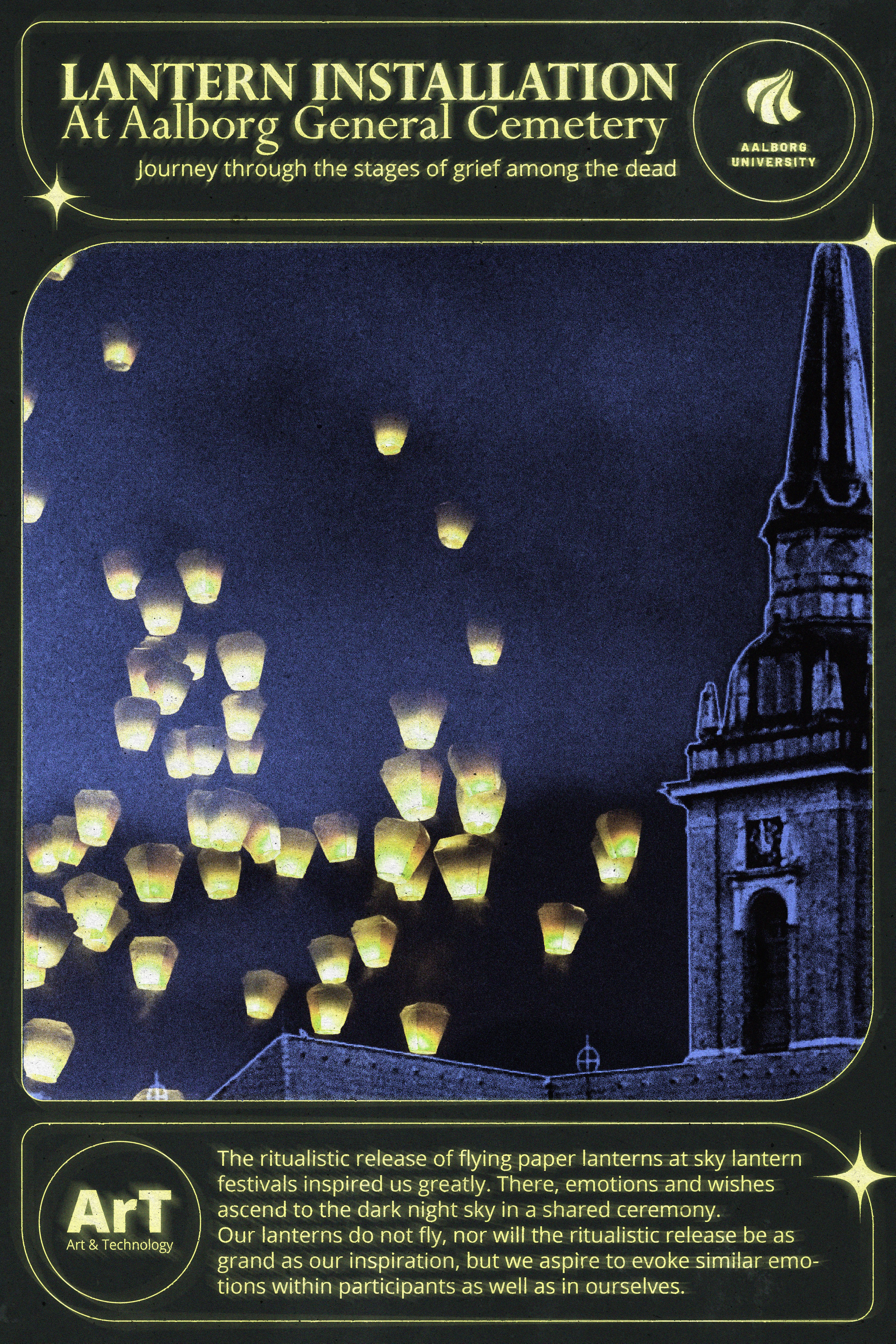
Cemetery Lanterns was a site-specific public installation at Almen Kirkegård in Aalborg. Four large lantern sculptures formed a walking route through the cemetery, leading visitors back to a disused columbarium where they could make, inscribe and either keep or leave behind a small lantern of their own.
The cemetery was not simply a backdrop for the work. Its spaces, paths, graves, and history itself became part of the experience.
01 / Site
Reading the cemetery
Before designing the installation, we investigated how Almen Kirkegård was already being used. It functions simultaneously as burial ground, historical site, walking route and park-like public space, with people visiting graves alongside people walking dogs, exercising or simply passing through; a space of both ritualistic, communal mourning and mild leisure.
Maps, spatial analyses and a topographic terrain model helped us understand paths, landmarks, movement and the relationship between the cemetery, its facilities and the places surrounding them. Rather than selecting a single exhibition spot, we chose to construct a route through the existing landscape.
The sensitivity of the site also shaped the project. We worked directly with the cemetery's caretakers, and illustrated a proposal for approval by the administration. The installation was deliberately developed to coexist with ordinary visitors rather than dominate the space. The specific conditions seemed a limitation at first, but later became integral to the project.


02 / Procession
Walking the site
Four large lantern sculptures were positioned around the area surrounding the columbarium. Together they formed a loose sequence based on the stages of grief: each lantern acted as a visual marker along a path that visitors were invited to follow before returning to the building.
But the walk itself became at least as important as the objects marking it. Moving between the lanterns meant moving through an active cemetery: past graves, trees, paths, memorials and people using the space for reasons entirely unrelated to the exhibition.
The installation therefore borrowed much of its atmosphere from something that was already there. Distance created pauses between encounters, while the surrounding cemetery supplied a context that no freestanding sculpture could reproduce.
Rather than constructing an enclosed experience, we placed a sequence inside an existing one. The visitor was never only moving through the artwork; they were moving through Almen Kirkegård.
In that sense, the route was not simply a way of connecting four sculptures. It was one of the project's primary artefacts — a temporary choreography imposed lightly onto the cemetery's existing paths.


03 / Markers
Faces in the dark
The large lanterns were approximately one metre tall, but their importance was less as finished sculptural objects than as interruptions distributed through the landscape.
Each contained a pale mask suspended inside a dark enclosure. The contrast made the faces appear detached from their structures — less like portraits than anonymous presences encountered along the walk. The masks themselves corresponded loosely to different emotional stages commonly undergone in the process of mourning.
Retrospectively, I believe their ambiguity served the project better than their intended symbolism did. They did not need to convincingly depict a specific emotion to make a visitor stop, look, and register that something unfamiliar had appeared among the familiar visual language of graves and memorials.


04 / Participation
Leaving something behind
The walk ended where it began: inside the old columbarium.
Visitors were then invited to assemble small laser-cut lanterns, write or draw something on them, and decide whether to take them away or place them inside one of those niches. As the exhibition progressed, the empty wall gradually filled with coloured lanterns, each containing something from a visitor, ranging from simple initials or symbols to apologies, anger and short reflections on lost people or relationships.
Thus, through the participation of friends and strangers, our cemetery intervention became one choreographed by us and by our visitors in a communal "release" of lanterns; not something we made alone. It was the collection that accumulated through participation:
The disused columbarium — a room once built to hold the remains of the dead — temporarily became a place where living visitors could leave traces of memory, loss and reflection.


05 / Additional media
Gallery