2024–Ongoing
MIKMAT.net
Cultivating my living archive.
00 / Summary
MIKMAT.net began as an online résumé—a way to make a multidisciplinary practice legible when a conventional application could not. Rebuilding it in Framer gradually transformed it into a living archive: one I can return to, revise and continue to build.
The website has become a project in its own right: not only a container for my work, but another demonstration of it.
01 / "MIKMAT"
A place for the work
‘MIKMAT’ is essentially just a contraction of my name; Mikkel Mathiasen. The short, pronounceable name was originally practical—it is short, easy to transmit in documents and can survive outside a hyperlink. Over time, it has become the name of a place where my work gathers.
The emblem arrived after the first site was made. I wanted a sigil that could work as a favicon and establish a tone before anyone entered the site. An eye and glimmer signifying my practice on design and art. Its textured square borrows an image from my earlier project Neon Dream; even the identity contains a piece of the work it was made to hold.
Before the visitor reaches the first project, a fragment of the archive has already entered its identity.
Sigil anatomy


Colour system
The colours began in yarn and accident. Their earliest source was a sweater I wore in a photograph, later carried into my résumés and personal documentation. As the palette matured into a bright and colourful system, those accidental colours acquired a material mythology of their own:
Lazurite Blue, Auric Yellow, Steel Gray, Onyx and Porcelain White.
Lazurite Blue

Auric Yellow

Steel Gray

Onyx

Porcelain White

02 / VERSION 1.0
The squarespace site
I made the first version in Squarespace in the summer of 2024, initially for job applications. My work was varied, and I hoped that seeing the projects themselves would make my skills clearer than another paragraph in an application letter.
I built those pages mainly from images, illustrations and memory. The site gave the work a public address and an identity that I wanted to preserve.
While assembling it, I also surveyed the competencies I had developed through university and work. I distilled them into six overlapping disciplines: Experience Design, Prototyping, Design Thinking, Storytelling, Strategic Design and Critical Design. They were less a system for categorising projects than a way of articulating the practice connecting them.
The first site was essentially an online résumé.
As my ideas for the site developed, its structure began to feel too familiar. I had followed the conventions of other websites closely: a header, a separate project catalogue, a contact page with a form, and standard buttons and transitions. The contact page is a small example of the problem. A direct email link on the homepage could serve its purpose with less distance between visitor and action.
Squarespace had helped me publish the portfolio, but giving it a more particular structure meant working against its visual system or extending it through code. When I discovered a tool closer to the way I already designed - Framer - rebuilding the site became more compelling than continuing to modify the first one.
The work was mine, but its structure still carried the logic of the template.
On the 1.0 homepage, projects were relegated to a small section in the second half. The original 'about' page read like a conventional résumé. The project archive was its own separate page, and project pages were mostly just galleries.


03 / VERSION 2.0
Designing a new environment
In early 2026, I learned Framer while building the website for Grønning Design. Its visual way of arranging pages felt closer to tools I already used, such as Illustrator and Affinity. After finishing that site, I began moving MIKMAT.net to Framer.
At first, I intended to transfer the portfolio and flatten its structure. That change became the basis of a larger redesign. The first site had assembled my work within an existing system. With the current, I was designing the system itself.
Rebuilding the site meant designing not only its pages, but the environment through which they would be encountered.
Every environment needs a way to be read. Here, the navigation became a small handheld map.
The clearest expression of that change is the persistent project index. On wider screens, it remains visible beside whichever page the visitor is reading; on smaller screens, the same one-layer structure folds down from the top. Projects no longer sit behind a separate catalogue page. They remain visible as the principal contents of the site.
I think of it as a small handheld map. A visitor can see roughly how much there is to explore and choose a route without moving through several layers of pages.
Home:

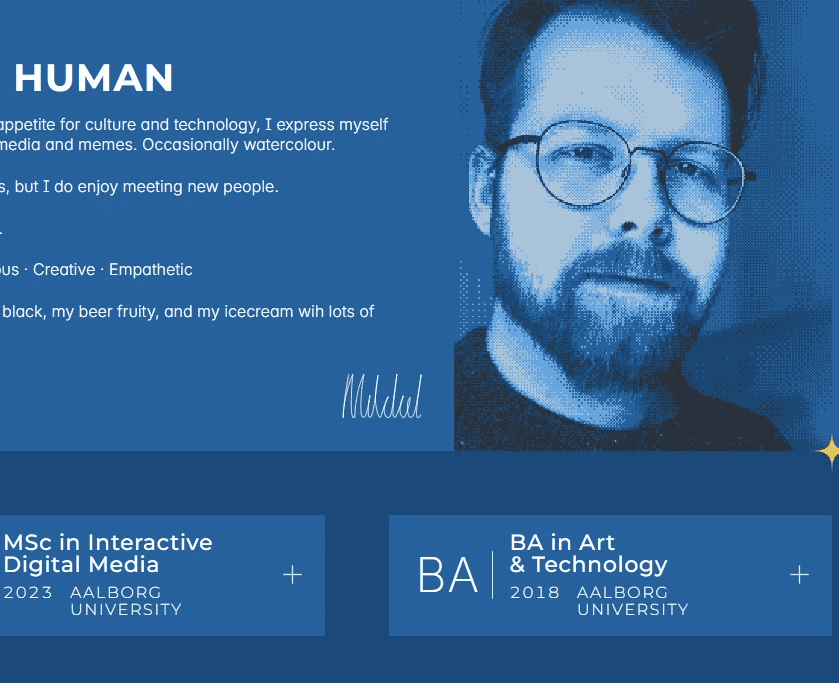
About:
Contact:
*Overlay

Projects:


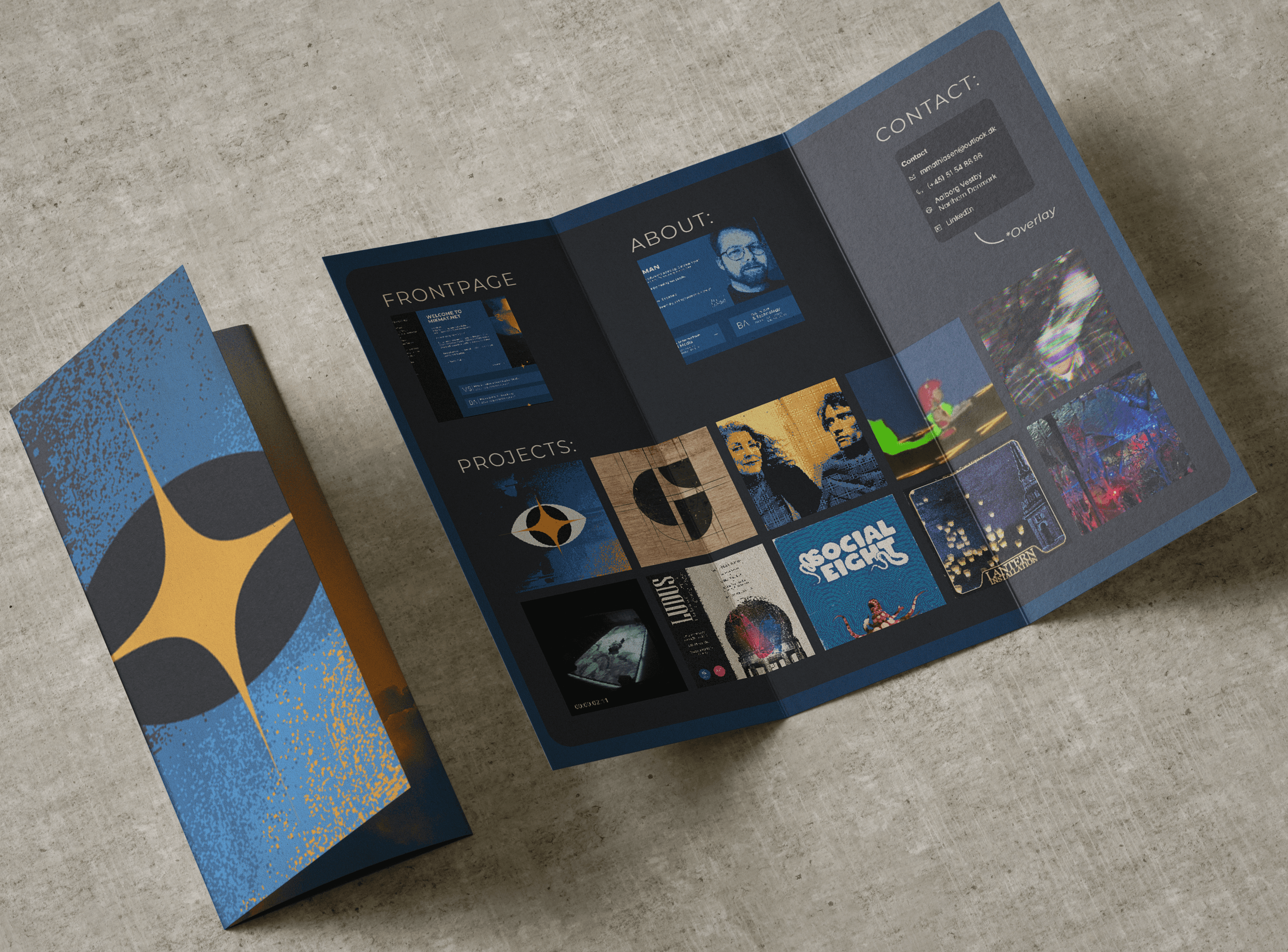
Projects no longer wait behind a catalogue page; they remain present at the edge of every story.
Each project page begins with a title and summary, then follows numbered chapters. Beyond that common starting point, its length, layout and rhythm can change with the material. I build the pages from a shared template and adjust them individually, because an installation, a game and a branding project do not necessarily make sense as the same kind of story.
Movement supports the structure rather than replacing it. Hover effects identify interactive elements, while the navigation remains stable as the pages beside it change. Small glimmers introduce some whimsy into an otherwise square and archival frame.

04 / Intrapersonal writing
A living archive
Calling MIKMAT.net an archive marks a change in both purpose and audience. A portfolio usually presents selected work to other people as professional evidence. MIKMAT.net still serves that purpose, but I have also become one of its readers. The projects are not only displayed; they are maintained, revisited and allowed to change.
As we manipulate, we touch and feel, as we look, we see; as we listen, we hear. The hand moves with etching needle or with brush. The eye attends and reports the consequence of what is done. Because of this intimate connection, subsequent doing is cumulative and not a matter of caprice nor of routine. In an emphatic artistic-esthetic experience, the relation is so close that it controls simultaneously both the doing and the perception.
- John Dewey in Art as Experience (1934) p. 51
An environment becomes an archive when it begins to hold time. MIKMAT.net contains finished projects, but not fixed interpretations. Documentation, memory and present-day judgement meet whenever I write a project story. The archive remains living because that encounter can still change its form.
Once I began transferring the projects, moving the existing text no longer seemed sufficient. Some earlier pages gave too little account of what had happened or what I had contributed. I returned to reports, presentations, photographs and video, using memory where the documentation left gaps.
That work has changed how I regard some projects. I can now see qualities in LUDUS and Cemetery Lanterns that I did not value much at the time. Revisiting them can also bring nostalgia and regret. Designing a personal archive means being both its author and one of its subjects.
These stories are therefore not neutral records preserved from the moment each project ended. They are historical recollections written in my present voice, informed by original documentation and by what has become visible in hindsight. The archive records earlier work, but its interpretation remains contemporary.
05 / Reflections
Ongoing
MIKMAT.net 2.0 is the current form of the site, but it is not intended as a final portrait. Its structure is established; the archive within it will continue to change as projects are added, revisited and rewritten.
Version 2.0 names the present environment, not its final state.
MIKMAT.net is complete as a place, but remains open as an archive.
The first MIKMAT.net helped me show my work to others. The current version has also given me a way to return to it.

06 / Additional media
Gallery