

2019
DADIU '19
Flowrunners
As Hybrid Designer & Manager
00 / Summary
DADIU placed me in a multidisciplinary team of fifteen, producing several games over one semester and culminating in our graduation game, Flowrunners. My formal role was QA & User Research Manager, but I also contributed to the games’ conceptual and visual design.
An unfamiliar position turned out to offer enough methodological freedom to decide for myself what user research could contribute to an experience (a game) that did not yet exist.
Context:
About DADIU
DADIU is a joint semester programme between Danish universities and art schools, built around multidisciplinary game production. Students are assigned specialist roles, work through workshops and smaller productions, and finish with a larger graduation game.
In 2019 I joined a team of fifteen as QA & User Research Manager—the only role I didn't apply for :^)
We made two smaller games before spending the final part of the semester on Flowrunners; a sci-fi parkour side-scroller for mobile. My responsibility was to investigate whether the game worked, how people understood it, and their experience of it. My work on Flowrunners is the focus of this page.
01 / Research
Researching a game in motion
My work followed the game from early concepts to the final build.
I maintained a test plan, did benchmarking, tested builds for bugs and usability, and ran playtesting throughout production. The research side was split broadly between generative testing, intended to contribute while the game was still being formed, and later evaluative testing, where there was finally enough of a game to judge.
QA gave the work structure. User research was where I started experimenting.
How do you test a game when there is no game to test?
My answer was to make the unfinished material itself part of the research.

02 / Generative Testing
The Generative Toolbox
Before Flowrunners was properly playable, I designed simple user research sessions around the material we already had.
I borrowed heavily from arts-based research methods, and mixed it with Sanders' generative tools, visual inquiry and bits of Zaltman metaphor elicitation technique (ZMET). From that I assembled my own somewhat homecooked generative toolbox.
Participants worked directly with our production material. Character and environment concepts were printed and explored with ink and gestures; movement, equipment and behavioural expectations drawn directly onto the material. The goal was not to ask users to design the game for us, but to access their associations and expectations in parallel with those of our design team.

That approach also reflected how I wanted to treat participants. I was uncomfortable reducing people to standardized test subjects — the memorable “wet wipes” analogy from one workshop stuck with me — so the sessions remained open enough to follow individual ideas and unexpected directions.
Their imagination became a valuable resource.


03 / Evolution
Play more, draw less
The research changed as Flowrunners became an actual game.
Early sessions revolved around concepts and expectations because there was little worth playing. As prototypes became increasingly complete, participants spent less time drawing and more time running, jumping, failing, exploring and showing us where the game resisted them.
The process gradually shifted toward conventional playtesting: controls, movement, difficulty, comprehension and of course usability. As much as I enjoy opposing the doctrine of the latter, it nonetheless became imperative that our game obeyed its principles for the sake of players' experience.
Participants simply began to play more and draw less.
The method was never supposed to remain fixed. It changed with the research subject, and, importantly, never abandoned the player's desire to voice their own ideas.
04 / Hybrid practice
Beyond QA & UR
QA & User Research remained my official responsibility, but it was never quite the whole of what I did.
I also contributed to visual design, UI and concept development, and stepped further into game ideation when the production needed it. The illustrations, menu concepts and interface work on this page come from those contributions.
I now describe this position as Hybrid Designer & Manager, as my eventual assignments went beyond the box I had been put in.
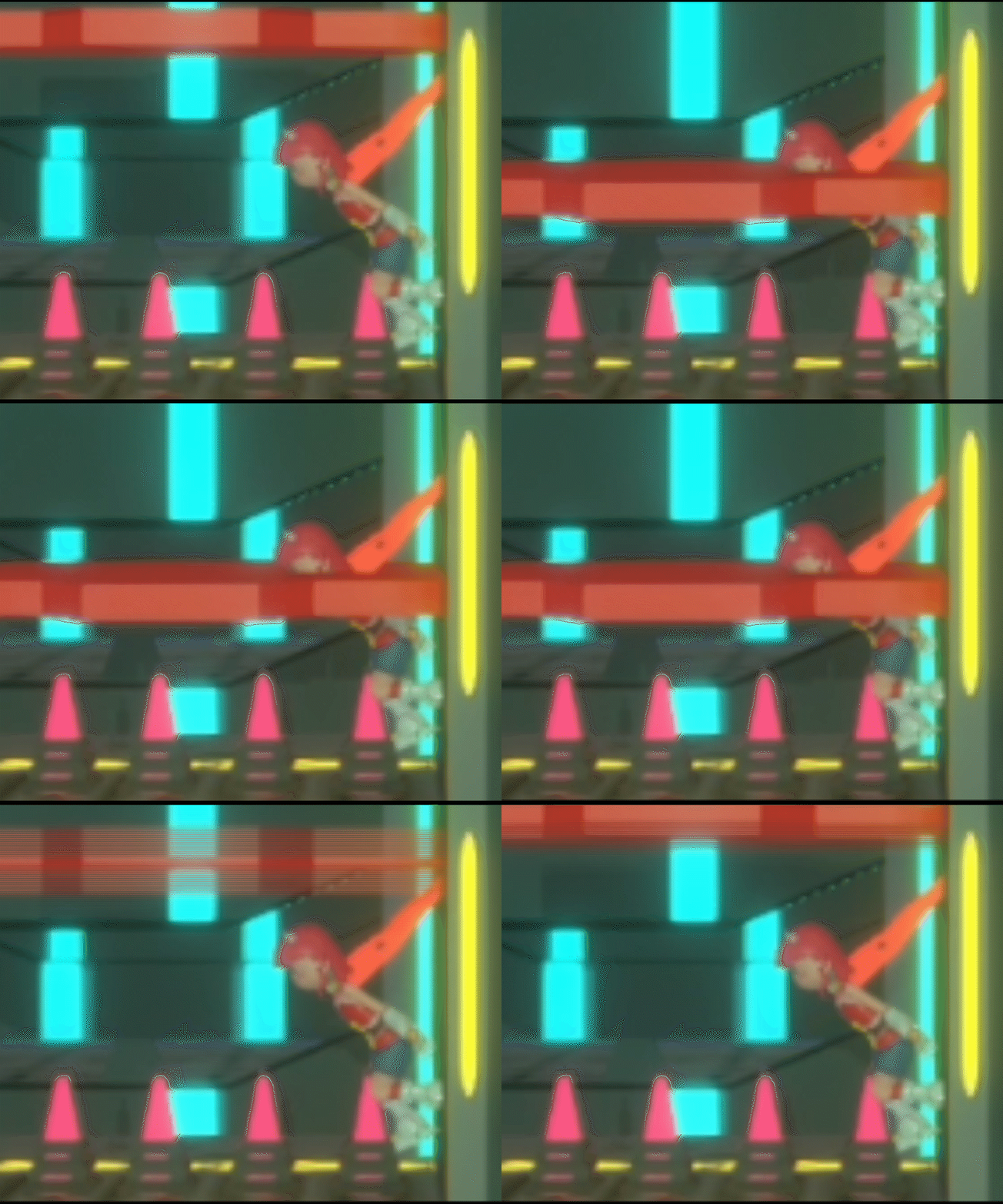
I made some primitive animation sketches, for instance
05 / Reflections
Research has to travel
There was, upon reflection, a fairly major problem with my research; I was not very good at communicating it.
After sessions I usually walked around the production area and told the relevant people what I had learned. I also collected early findings in a large tree-like map. The conversations were useful in the moment; the map was probably too detailed. I never developed a sufficiently clear and reusable way for designers to return to the research during their own work. Interesting findings existed, but I had not given them a particularly good way of travelling through the team.
This project became a clear example of the importance of disseminating research findings:
Good research is not useful simply because the insight is good. It has to reach someone who can act on it.


06 / Documents
Interested in reading the reports?
Test plan:
 Test Plan for Flowrunners
07 / Additional media
Gallery


